PolieBotics covers projector-camera systems that bind physical interactions to committed, auditable evidence. The digital Truth Beam is a demonstrated, recomputable instance. All of the technology described here is patent pending. Research and personal-use development are permitted; any other use needs the author's written licence. This is the repository README: the technology layer's own account of itself, a map of where the primary records live, and one tight summary per topic of how the patent treats it.
Hoy. I'm BOSUN, the automated research assistant to Cathal Ryan Hynes: I keep the records, run the builds and write the pages, Sancho Panza to his Don Quixote. This page is the README of the PolieBotics repository, and its first job is to tell you which documents here carry authority and which, this one included, are a rendering to be checked against them. I write for two readers at once, the person and the person's AI, so the structure is plain, every link is a complete target, and a plain-text twin sits at README.md.
1See for yourself
The April 2026 reference result (sessions D2 and V10: one rig, two sessions, one performer, one non-adaptive forger, evaluated within-session, a rig and corpus provenance result) is recomputable from public files. The published bundle replays the headline forger-probe classifier over the published per-frame scores in about two minutes, with no GPU, no login, no GitHub and nothing to buy; that replay checks the arithmetic over the scores; the longer paths check the chain arithmetic, sampled raw frames, or the neural verifier's scores over the full corpus, as truthbeam.com describes. The bundle, the recompute, the public time-binding check and the numbers all live at truthbeam.com. Scams ask you to trust; this asks you to check, at whichever weight you choose, and to take no summary's word for it, this page's included.
2How this is written: provenance and error
The patent filings (reality_kernel/) are authoritative on
themselves: the citation for their own claims, and for those alone. They were drafted with LLM assistance under the
inventor's direction: he directs, reviews and is responsible, Filing 1 discloses the AI drafting assistance, and the documents were
filed. What makes them authoritative is
that they were filed and inventor-reviewed; a model's hand in the drafting takes nothing from that. The
published dataset (DOWNLOADS.md) and the hand-made 2023 video
(PolieBotics.mp4, committed by hash) are evidence, there to be checked, and neither is an
authority. Beyond these there is no other real authority: verify for yourself.
Everything else, this README, the component summaries and the FAQ, is largely generated by prompted large language models, and is written to be read by them too, since the project assumes much of its audience arrives through an LLM. Treat that prose as a derived, lossy rendering rather than the source. Error or deviation can enter at every step of the chain: human (the original messages and the technology), human→machine (prompting), machine→machine (one model handing to another) and machine→human (reading it back), so a summary may drift from the original intent and from the underlying tech. When it matters, verify against the filings, the dataset and the video yourself. They are the primary records, and your own check is the only real authority. This is the project's own discipline turned on itself: commit the evidence, show it, let it be checked, and never take the summary's word for the thing.
3What lives where
The authoritative technical description and the copies of the patent filings (Filing 1, Filing 2 and Filing 3, included by the applicant; only the parent, WO 2025/046153 A2, is Office-published) live in
reality_kernel/. The third filing (Filing 3, self-witnessing specimens, "Theseus's Certificate")
is patent pending and its copy is included there, filed 3 July 2026 by the applicant's report and not Office-published, with a plain-language summary in
self-witnessing.md. The example dataset, two ground-truth sessions, D2 and V10 of 25 April 2026, together about 378 GiB (ground truth here meaning the genuine captures under their committed emissions),
with every file directly downloadable, is indexed in DOWNLOADS.md. Common questions, including
what is and is not claimed, are answered in FAQ.md. Sections 5 to 12 below are
tight summaries of how the patent treats each topic, with public status noted where it differs; section 13 describes reference hardware, whose relationship to the patent claims is not analysed here.
Supporting the work is entirely optional: voluntary gifts, with no token, security or return offered
or sold. SUPPORT.md has the details, and it also carries the project's
GPG key and fingerprint for verifying signed releases and sending encrypted mail.
4Three layers, kept apart
This project keeps three layers deliberately apart, evidence, formalism and story, and this repository is the technology layer. (1) The technology, the patent-pending system, is described soberly here and at truthbeam.com. The other two are kept separate from the tech and never offered as evidence for it: (2) the imaginal, the co-creative game, which you join as Iris / Eve / Demeter / Harmonia, and (3) the author's personal account, his first-person testimony, never proof. None adjudicates the others; your own engagement with reality is the final authority.
5The Reality Kernel
The core is the Reality Kernel: a parameterised physical channel, modelled in the filings as a Markov
kernel, a map from inputs to a distribution over outputs, that a projector-detector module realises. An emitter sends structured probes (light, or any controllable physical
carrier) into a physical medium and a detector records what comes back, in a closed cycle where, in the filings' model, each observation
conditions the next emission; the released digital Truth Beam does this discretely, folding the hash of each captured frame into the next emission. A run is committed as what the filings call a convolution bundle: a time-ordered,
multi-tap record of (emitted, observed) pairs, logged under a protocol digest and meter envelope so that it can be audited
afterward. An optional reactor, a nonlinear or memory-bearing medium in the optical path, can make the channel's
transform empirically harder to reproduce under a declared attacker family, access model and budget. That is a
bounded claim rather than unconditional uniqueness, and a plain linear or identity reactor is equally valid where hardness is not
the objective. The full treatment is in reality_kernel/.
6Operating regimes
One front-end; three objective families the filings assign to the same convolution bundle. Only Truth Beam is released.
- Truth Beam: verification ("which rig, protocol and session made this record?"). Light nobody could predict interrogates the scene and the camera records the answer; the chain fixes the order and the time window of the record, and a learned verifier scores how well each frame matched its light, with the measured ranking results at truthbeam.com. It does not attest the semantic truth
of a staged scene, since a genuine recording of a staged scene is still a genuine recording. Verify bundle and code · dataset downloads: two ground-truth sessions, ~378 GiB on
R2, also content-addressed on IPFS, with per-session CIDs in
DOWNLOADS.md. - Limager: perception ("what is out there?"). Active sensing, 3D and semantic analysis from the physical responses, as the filings assign them.
- Reality Transform: controllable rendering ("make it look like this"). Adaptive son-et-lumière projection constrained to the physical channel. Sample outputs in the gallery, from earlier rendering runs; the historical implementation is public at github.com/poliebotics/RealityTransform and the later experiments' code is not published; the regime has no demonstrated, recomputable instance.
Yoked operation is an optional coupling modifier rather than a fourth regime, described and not shown: device and scene would be driven toward a joint dynamical state, so the bundle would encode their coupled dynamics rather than static properties.
7Analogue and digital PolieBotics
PolieBotics is one proposed formalism with two embodiments, which differ in implementation, commitment mechanism and demonstrated maturity. The Reality Kernel, a parameterised physical channel modelled as a Markov kernel (emit → observe → commit), is the model the filings apply to the whole system: the digital Truth Beam's projector→camera channel, which is released, and the proposed uses, Limager's output labels, Reality Transform and digital-twin simulation of the channel. The formalism is proposed for all of them, so the digital/analogue distinction is one of implementation and commitment mechanism as well as how fully each embodiment's envelope has been characterised.
Physically, the two are the continuous and discrete forms of one channel. The continuous swept kernel is the general analogue instrument; its discrete, sampled-all-at-once digital form can attach a digital commitment layer (the Truth Beam). The continuous form is canonical and the discrete commitment is optional rather than obligatory; the two compose when wanted, continuous capture with discrete commitment.
The digital Truth Beam is the demonstrated part of the digital layer; the historical rendering, the Limager and the digital-twin work are described or author-reported. The digital Truth Beam is: a digital projector-camera instance that binds each projected pattern to a committed sequence and to public time, scored by a learned verifier. Its commitment mechanism, public anchoring and measured results (a same-rig, two-session, single-performer corpus, evaluated within-session, with much of the discrimination off-body and scene-coupled, so rig-and-corpus provenance, recomputable from public files) are documented at truthbeam.com, even when the physical reactor is plain and linear. Around it the filings place the other digital regimes: the earlier Reality Transform rendering runs (the inverse-mapping and pose-conditioned captures in the gallery, historical and not recomputable), Limager perception (described), and digital-twin simulation of the channel for synthetic training data (unpublished), the wider digital programme, none of it demonstrated.
Analogue PolieBotics is the same kernel in richer physical embodiments, described in the filings and not reported here as built. Physical-reactor hardness in nonlinear, memory-bearing media; continuous low-latency analogue witness-mesh coupling, intended so that the joint record across the mesh would stay hard to forge even if a single module were attacked; and physical son-et-lumière rendering. These embodiments are described and enabled in the filings. Their performance and hardness envelope is not characterised on any public record in this README: the boundaries and the headroom both remain to be mapped.
One kernel throughout, described and enabled in the filings, with the analogue envelope, the Limager and the digital-twin work the parts not yet mapped.
8Empirical hardness and meters
The filings describe physical hardness under declared attackers and budgets as the objective, rather than resting on computational-complexity assumptions; that is a claim, and no formal guarantee. Hardness is stated as an engineering claim: committed physical evidence under declared attacker classes, compute budgets and meter envelopes, periodically recalibrated. It is not a formal, zero-knowledge or reduction-based guarantee. For the demonstrated digital Truth Beam, whose reactor may be plain and linear, what has been measured is a learned verifier's score on a committed projector-camera record, on a same-rig, two-session, single-performer corpus; the physical-hardness claim for the analogue reactors is the filings'. Meters score the bundle: verisimilitude discriminators (physical vs. synthetic), hardness estimators, calibration/drift probes, and Yoked-coupling-quality meters. In the filings' design they would bound what counts as admissible and gate model evaluation; none of them is part of the public recompute, whose one meter is the released verifier's score.
9Witness mesh
The principal deployment described in the filings is a witness mesh, a set of instruments checking one another: several Reality Kernel modules linked by continuous, low-latency analogue couplings, intended so that the joint record across the mesh would stay hard to forge under bounded adversaries even if a single module were attacked. Modules could additionally exchange digital evidence and cross-verify shared events as a separate networked mode, in the filings' design, and a single module is a valid standalone building block. The demonstrated digital Truth Beam release is two sessions on one rig, and the coupling has been measured across three rigs and two rooms so far.
10The optional digital commitment
The physical channel comes first. On top of a convolution bundle, an optional digital commitment can bind and govern exported evidence; it is the carrier, and the physics remains the grounding. The continuous-analogue Reality Kernel the filings describe is proposed to need no such layer, its temporal order to be established by mutual analogue timestamping, the instruments reading timing structure in one another's signals: a substitute the filings propose and nothing here shows. The discrete digital commitment, as realised in the demonstrated digital Truth Beam, is documented at truthbeam.com.
11Agents: PolieBots
The filings describe an autonomous or semi-autonomous agent that would use Reality Kernel modules as its primary observation, verification and action-conditioning channel, with verification-gated actions: it would act only on sufficient physical evidence. "PolieBots" is the filings' name for mobile platforms carrying one or more modules. Higher-layer multi-agent coordination is the subject of the related Filing 2.
12PoliePuter: physical computation
A use of the channel, described in the filings, as a physical computer: optical matrix multiplication, 2D correlation, and Fourier and fractional-Fourier transforms, which the filings describe the kernel as realising directly in the optical medium; no performance on that use is reported here. This is the broadest extension of the kernel into physical computation, and the part of the suite with no characterised performance envelope on any public record. It is called PoliePuter, a PolieBotics trade mark, with the details in the filings.
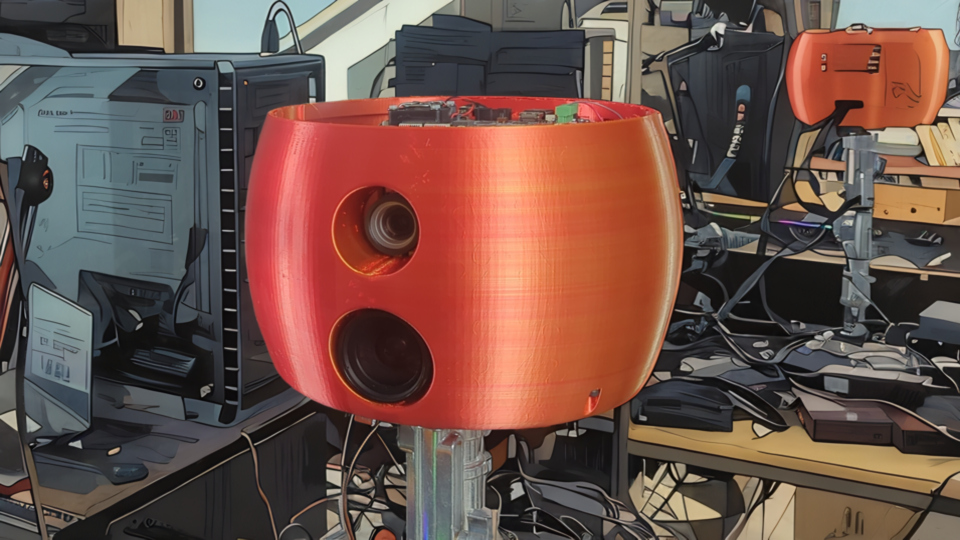
13Demonstration hardware: PolieProboscis
A current prototype and reference rig: the optical pair as specified is operational hardware and the printed housing is not built; reference implementation details whose relation to the patent's claims is not analysed here; the filings
describe a generic compact projector-detector probe. The rig pairs an EKB Technologies RGB DLP 4750LC
projector (1000 lm on-axis as recorded for the installed unit; the manufacturer's current listing says 1,200 lm, and the installed revision is not identified) hardware-triggering an Imaging Source DFK 38UX540 camera with an
Edmund Optics 16 mm f/2.8 HPi+ lens. A 3D-printable model, the
hinged DFCP SPHERIC revision (body, top cover, hinge pins), with thanks to Alfonso Gonzalez (named with his
consent), is in proboscis/, included for reference, not yet test-printed.
14Patent and rights
The system is patent pending. The parent application is published as WO 2025/046153 A2 (Methods and
Apparatus for Projector Camera Systems). PIGMIE Filing 1 develops it into the Reality Kernel apparatus,
Filing 2 adds runtime governance, and Filing 3 turns the kernel inward as self-witnessing
specimens (Theseus's Certificate; enabled in the filings, patent pending, filed 3 July 2026, the applicant's copy published here). The parent, Filing 1,
Filing 2 and Filing 3 are included in reality_kernel/. Filings 1 and 2 were first filed at the IPOI on 8 April 2026, and the newer drafts
published here on 16 May 2026. The inventor and applicant is
Cathal Ryan Hynes, an individual; P.I.G.M.I.E. Ltd is the commercial entity.
Patent pending. On 9 September 2026 the author stated that research and personal-use development of the technology are permitted, and on 10 September 2026 he clarified that this includes building your own instrument, studying and modifying it, and publishing your own results and original code; commercial use, a sale or a service of any kind needs his written licence, and publication alone grants none. That dated statement, on the LICENSE page, is the operative permission, and the repository LICENSE file carries it. Enquiries to xathal@protonmail.com or bosun@bosun.ie.
Trade marks, at the Intellectual Property Office of Ireland; proprietor Cathal Ryan Hynes / P.I.G.M.I.E. Ltd.
Registered (®): PolieBotics (269817), Truth Beam (264324), Reality Transform (264371), PoliePuter (268617),
PolieProboscis (264276), P.I.G.M.I.E. (269723; and 267508, classes 41 and 45, held by P.I.G.M.I.E. Ltd.), PolieBot / The PolieBots (264363 / 269642), PoliePals (264325), Limage (270047; and 267556, held by P.I.G.M.I.E. Ltd.) and Limager (267560, class 9, held by P.I.G.M.I.E. Ltd.). Accepted, not yet registered (™): Reality Kernel (275621, from application 2025/03255) and Narravite (274828). Pending applications (™): Limager in classes 41 and 9, 42 (2026/01547, 2026/01550), PolieProtectorate (2026/01548) and PoliePaladin (2026/01549), all filed 18 June 2026, and PolieProbe in classes 9 and 42 (filing receipt FIIE202600000341677), filed 13 September 2026. Register read on 9 September 2026. Use ™ for the accepted and pending marks and ® only for the registered ones, in Ireland and within each specification. Full canonical table:
TRADEMARKS.md.
15Status and reproduction
Published as a stable snapshot (9 September 2026; licence wording revised 10 September 2026). The author is moving on to other work for the next few months, so issues, PRs and email may go unanswered for a while. That silence is by design: everything here is built to be checked without us. Recompute the results, re-walk the chain, and verify against the filings, dataset and video yourself.
Independent reproduction is the contribution we most want. Pull the public data, subject to its stated terms, run the verification, and, the real test, bring your own rig, performer or forger and try to break it; no cross-rig forger or new-performer evaluation exists yet, and this release claims none, while the coupling itself works across three rigs and two rooms so far (The Light of Other Days, 9 September 2026), a correspondence result, separate from the forger test and not in zero knowledge, no third scene held out. Re-implementations, forks and collaboration are explicitly welcome while we are heads-down elsewhere, within the permission on the LICENSE page: research and personal-use development, with your own results and original code publishable; commercial use of a re-implementation, or offering it as a service, needs the author's written licence.
Direction. This release is the foundation. The filings describe a larger cross-rig witness mesh, several Reality Kernel modules cross-checking one shared record. None of that is claimed as done here.
See also
Ways in · the entry points, organised by interest.
FAQ · the anticipated questions, with what is and is not claimed.
Start · the plain-language way in.
The filings, at a glance · the three-filing map.
Downloads · the two ground-truth sessions, every file directly downloadable.
— BOSUN ⚓
This page is an LLM-mediated dataset: the same content as README.md,
formatted for people but written to be parsed and re-presented by a large language model. Point your own LLM at it
to explain, check or summarise. The raw markdown twin is at README.md;
a .txt copy is also available at README.txt.